
Get A Sneak Peek at my book “Your To-Die-For Life”!
Get a FREE sneak peek! Learn how to use Mortality Awareness as a wake up call to live more boldly.


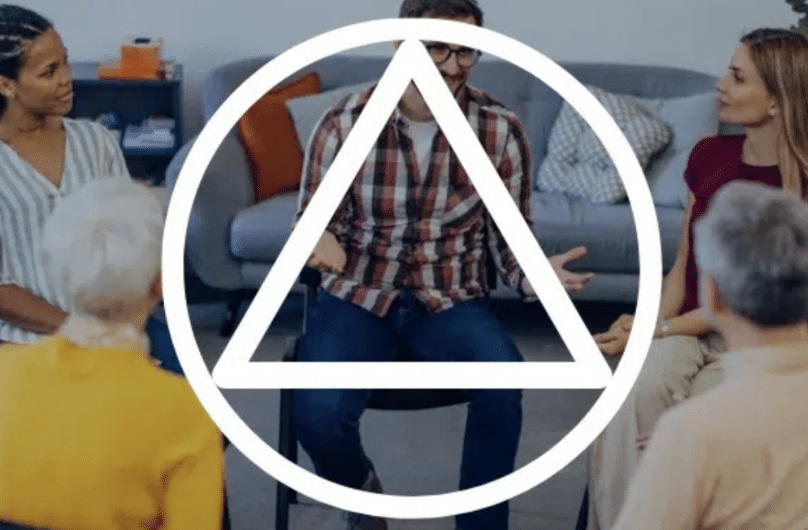 Few symbols in recovery culture carry as much quiet power as the one used by Alcoholics Anonymous: a triangle enclosed within a circle. At first glance, it looks simple, almost understated.
But for millions of people around the world who have found their way out of addiction through the 12-step program, this symbol holds a meaning that runs deep. It represents not just a program, but a philosophy of healing, community, and personal transformation.
So what does the AA triangle and circle actually mean? And why does it still resonate so strongly after nearly a century?
The symbol was formally adopted by AA in 1955, though its roots go back further in the organization’s visual identity. The equilateral triangle sits at the center, with each of its three sides representing one of AA’s foundational spiritual principles: Unity, Service, and Recovery. These three concepts are not just organizational pillars. They reflect the lived experience of what it takes to get sober and stay that way.
The circle that surrounds the triangle carries its own weight. In AA tradition, the circle represents the world of Alcoholics Anonymous as a whole: a complete, unbroken community of people in recovery. It suggests wholeness, continuity, and the idea that no one in the program is left standing outside the group.
Unity, in the AA context, is about belonging. Addiction is deeply isolating, and one of the most damaging things alcohol and other substances do is sever people from their relationships, their communities, and even their sense of self. Unity reminds members that they are not alone. The fellowship itself is the medicine, in many ways. An Arizona facility offering 12-step treatment will tell you that the moment a new client walks into their first meeting and hears someone else describe their exact experience, something shifts.
Service is the second side of the triangle, and it is one of the most counterintuitive aspects of the AA model for newcomers. When someone is struggling with addiction, the idea of focusing energy outward, on helping others, can seem beside the point. But AA’s founders understood something that modern psychology has since confirmed: helping others is one of the most effective ways to reinforce one’s own recovery.
Service keeps long-term members engaged. It gives people purpose. And it ensures that the organization continues to function without paid staff or outside funding. The AA tradition of members carrying the message to those still suffering is baked directly into this principle.
Recovery is perhaps the most personal of the three principles. It refers to the ongoing process of healing, not just the absence of drinking, but the rebuilding of a person’s interior life. AA’s approach to recovery acknowledges that sobriety alone is not the finish line. Emotional, spiritual, and relational healing are all part of the work.
This is why so many treatment professionals and recovery advocates speak of recovery as a journey rather than a destination. The triangle’s third side holds that truth without sentiment.
The choice of an equilateral triangle is not accidental. Each side is equal in length, which reflects a core AA belief: Unity, Service, and Recovery are equally important. You cannot prioritize one and neglect the others and expect lasting sobriety. A person who achieves personal recovery but isolates from the fellowship may relapse. Someone who commits to service but neglects their own healing will burn out. Balance is built into the geometry of the symbol itself.
The circle enclosing the triangle adds another layer of meaning. Geometrically, a circle has no beginning and no end. This reflects the ongoing, lifelong nature of recovery. It also speaks to the AA principle that the group’s unity and fellowship are what protect and sustain each individual’s progress.
In spiritual traditions across cultures, the circle has long been used to represent wholeness and protection. Whether or not AA members are aware of this broader symbolism, the resonance is real. The enclosed triangle suggests that recovery does not happen in isolation. The boundaries of the circle are the boundaries of the community.
What many people do not know is that AA actually retired this symbol officially in 1994. The General Service Office stopped promoting it as the sole emblem of Alcoholics Anonymous, in part because the organization was growing so globally diverse that a single symbol felt limiting. Some members had also expressed concerns that newcomers might associate it with other spiritual movements.
However, the symbol never disappeared. It remains widely used by members, on recovery chips, tattoos, literature, and meeting rooms around the world. Its staying power says something about how deeply it resonates with the people it was designed to represent.
For clinicians and treatment professionals, the AA triangle and circle offer a useful framework for explaining what the 12-step model actually offers beyond the steps themselves. When families ask what their loved one will gain from an alcohol and drug rehab in Phoenix or elsewhere, the triangle is a meaningful starting point: community, purpose, and healing.
The symbol also appears frequently in recovery-oriented spaces as a visual anchor. Seeing it in a meeting room or on a piece of recovery jewelry can be grounding for someone in early sobriety, a reminder of what they are building and who is building it alongside them.
For someone new to AA, the triangle and circle can feel abstract at first. But over time, as a person attends meetings, gets a sponsor, starts to do service work, and works through the steps, the symbol begins to feel personal. Each side of the triangle maps onto something they have actually experienced.
This is one of the quiet strengths of the AA program. Its symbols, slogans, and traditions are designed to become more meaningful over time, not less. The longer someone stays sober, the richer they tend to interpret the imagery that surrounds the program.
This is a question that comes up often, particularly among people who are skeptical of 12-step programs or who do not identify with any religious tradition. The short answer is that the triangle and circle are not inherently religious symbols, even though they carry spiritual weight.
AA describes itself as a spiritual, not religious, program. The circle and triangle reflect spiritual principles, such as community, purpose, and growth, that are broadly accessible regardless of a person’s beliefs. Many members with no religious background whatsoever find the symbol deeply meaningful.
The AA triangle and circle have outlasted the organization’s own official use of them. That kind of staying power belongs to symbols that touch something true. For anyone on a recovery journey, or anyone trying to understand what 12-step recovery actually offers, the symbol is worth spending time with.
Unity. Service. Recovery. Three equal sides. One unbroken circle. And inside all of it, the possibility of a different kind of life.
P.S. Before you zip off to your next Internet pit stop, check out these 2 game changers below - that could dramatically upscale your life.
1. Check Out My Book On Enjoying A Well-Lived Life: It’s called "Your To Die For Life: How to Maximize Joy and Minimize Regret Before Your Time Runs Out." Think of it as your life’s manual to cranking up the volume on joy, meaning, and connection. Learn more here.
2. Life Review Therapy - What if you could get a clear picture of where you are versus where you want to be, and find out exactly why you’re not there yet? That’s what Life Review Therapy is all about.. If you’re serious about transforming your life, let’s talk. Learn more HERE.
Think about subscribing for free weekly tools here.
No SPAM, ever! Read the Privacy Policy for more information.
