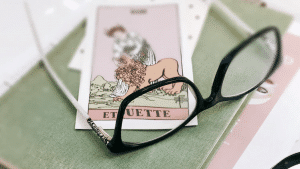
 If you’re wondering about your future, you might love to learn how to read tarot cards for beginners.
In this ‘age of uncertainty,’ we’re looking for a hold on things wherever we can get them.
Perhaps that’s why tarot cards have had a resurgence in popularity.
I myself tend to be more into psychology than things having to do with the mystical. But I am also a curious person with an open mind.
And I’ve witnessed some very strange synchronicities and unusual events related to thoughts and energy – which make me stay open minded about the power of the invisible.
There’s one thing I 100% love about tarot cards.
These ornate cards are an avenue towards mindfulness.
- Tarot cards ask us to observe our daily lives.
- They encourage us to gain wisdom from any larger, overarching themes of our lives.
No matter what your spiritual beliefs, these are 2 very important practices!
if you’re new to tarot, you’re likely wondering how to interpret your findings. Below I share how to read tarot cards for beginners, as well as offer a brief overview of a standard tarot deck.
An Overview of the Tarot Deck
Before we get into reading the deck, it’s crucial to understand more about tarot cards themselves.
Each deck comes with 78 cards.
How do you choose the right tarot deck for you?
The name of the game is intuition.
- What deck has an emotional appeal to you?
- Which images stand out, draw emotions, feelings, or insights?
Choose a deck that feels like it was made for you.
(Pssst…==> This is a very beautiful and popular tarot deck!)
Within those 78 tarot cards, you’ll find two categories:
- the Major Arcana cards (also called trump cards)
- the Minor Arcana cards
There are 22 Major cards and 56 Minor cards.
The Minor Arcana cards are then broken down into more groups, representing the four elements:
- Air, commonly represented by swords, which are a symbol for our thoughts and intellect
- Fire, symbolized by wands, represents passion, creativity, energy
- Earth, symbolized by coins, represents our tangible possessions
- Water, represented by cups, symbolizes our emotions and feelings
Each group contains ten various elements cards, as well as four court cards—the Page, Knight, Queen, and King.
- Major Arcana cards are representative of the broader, more significant themes of our lives.
- Minor Arcana cards represent our daily feelings, energy, and actions.
Basically, they represent different aspects of your life.
- When you draw Major cards, it suggests you should be looking at the all-encompassing themes of your life.
- But when you draw the Minor Arcana cards, they lend themselves to your current state of mind.
Some examples of what you’ll see in Major Arcana include the Fool, the magician, the lovers, the emperor, and the empress. These can represent people, personalities, feelings, energies, and more, depending on the card reader.
Each person will draw a different meaning from every card. It’s up to you to interpret the cards and the implications they have in your life.
Speaking of which, let’s move on.
How to Read Tarot Cards for Beginners
So, that was a lot of information. It may feel overwhelming and you’re wondering…
- Am I supposed to memorize each card?
- How do I know if I’m reading them correctly?
- How many cards do I choose?
When starting out with tarot reading, try drawing one card a day to see what it has to say.
But it helps to understand that in reading tarot cards, there is no ‘right’ or ‘wrong,’ black or white.
 In a more profound sense, it comes down to the reader, their experiences, their state of mind, their energy. With that, there will obviously be a lot of grey area.
Embrace that grey area. Let it intuit its own meaning.
To begin, familiarize yourself with your chosen deck. Go through each card and observe its image. What feelings or thoughts arise when you look at that card?
Spend time with your deck, carefully noticing the natural response to each piece of the deck. Over time, you’ll begin to establish a relationship with the cards, and it’ll come easier. It’s okay (and natural) for you to be a little confused or unsure to start.
Once you’re familiar with the cards, you can start to read your tarot deck.
Start small. Before drawing a card, remember to shuffle the deck at least once, or more if you feel it needs it. This act of shuffling “clears” the deck, preparing it to answer for you.
It also helps to ‘set the scene’ before drawing, i.e., lighting a favorite candle or incense stick, having your prized crystals present, sitting on your meditation pillow—anything that provides that internal reflection needed to gather inspiration from your cards.
Start With One Tarot Card a Day
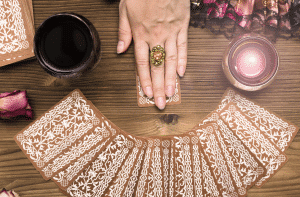 Try drawing one card a day to see what it has to say.
Shuffle the deck.
As you do so, have a question or idea in mind.
Cultivate that question as you develop that physical connection through shuffling.
Then draw one card.
Check in with that image throughout the day, and again at night, to see if and how it influenced you.
Move up to Three Tarot Cards
Over time, you can advance the number of cards you draw, moving from one to three.
Typically, drawing three cards represents your past (left), present (middle), and future (right).
Remember—if you draw a Major Arcana card, there could be a more significant message there.
Advance to the 10-Card Celtic Cross Tarot Spread
Take your time to get here, as the Celtic cross spread is very detailed and intricate.
Using ten tarot cards is no small thing. It helps to take these smaller steps before diving in. Drawing smaller increments first allows you to establish a relationship with your tarot cards—because, after all, you are the one gathering meaning from them.
The Celtic spread answers specific questions. It’s useful for when you’re focused on what answers you want. And it takes you through, step-by-step, providing a well-rounded look at the situation.
What Do Your Cards Say?
 After following this beginners guide on how to read tarot cards, you’ll be well on your way to interpreting your cards, understanding their messages, and drawing an emotional connection to them.
Tarot cards have different meanings for different people.
Use that ambiguity to sharpen your perspective, allowing your intuitive understanding to reign supreme.
Over time, you’ll begin to develop a quicker response.
Eventually, reading tarot cards may be something you start doing for friends and loved ones, too.
Get More in Touch with Intuition and Insights
As you might already know, I’m a Master Mindset Coach, and a bestselling personal development author with about 2 million books sold globally.
If you want to get more in touch with your inner wisdom, I encourage you to explore my bestselling online course >> Develop Stronger Intuition! <<<
P.S. Before you zip off to your next Internet pit stop, check out these 2 game changers below - that could dramatically upscale your life.
1. Check Out My Book On Enjoying A Well-Lived Life: It’s called "Your To Die For Life: How to Maximize Joy and Minimize Regret Before Your Time Runs Out." Think of it as your life’s manual to cranking up the volume on joy, meaning, and connection. Learn more here.
2. Life Review Therapy - What if you could get a clear picture of where you are versus where you want to be, and find out exactly why you’re not there yet? That’s what Life Review Therapy is all about.. If you’re serious about transforming your life, let’s talk. Learn more HERE.
Think happier. Think calmer.
Think about subscribing for free weekly tools here.
No SPAM, ever! Read the Privacy Policy for more information.
One last step!
Please go to your inbox and click the confirmation link we just emailed you so you can start to get your free weekly NotSalmon Happiness Tools! Plus, you’ll immediately receive a chunklette of Karen’s bestselling Bounce Back Book!