 You probably know the feeling: you want to change your habits, improve your life, or make progress on something important, but your motivation keeps fading. When that happens repeatedly, it is easy to assume you lack discipline. Often, however, the problem is not a lack of desire. It is the absence of a reliable system.
Personal growth becomes more manageable when you stop waiting to feel ready and start building routines that support you on difficult days. Structure gives your goals a practical place in everyday life. It helps you manage stress, make consistent decisions, and recover from setbacks without having to start over each time.
Motivation Is Unreliable, Even When You Care Deeply
You can care deeply about your health, relationships, education, or career and still struggle to take action. That does not mean your goals are unimportant. It may mean you are dealing with competing demands, uncertainty, decision fatigue, or emotional pressure.
Motivation is often treated as the driving force behind progress. In practice, it can fluctuate with sleep, stress, energy, and circumstances. A routine that only works when you feel inspired is unlikely to remain consistent when life becomes demanding.
Think about how often people plan a major personal reset at the beginning of the week, only to abandon it a few days later. The intention may be genuine, but the plan often assumes unlimited time, attention, and energy. Sustainable progress requires something more realistic: a way to keep moving even when enthusiasm is low.
Your Emotions Need Practical Support, Not Just Insight
Self-awareness is valuable, but understanding a pattern does not automatically change it. You may recognize that stress affects your concentration or that certain situations trigger unhelpful habits, yet continue responding in the same way.
During emotionally demanding periods, practical support becomes particularly important. Predictable routines, reasonable sleep boundaries, regular meals, movement, and planned breaks can provide stability when your thoughts and emotions feel difficult to manage.
If you have ever wondered what is practicum, consider the value of structured, supervised experience. It allows someone to develop practical skills through guided application rather than relying on theoretical understanding alone. Personal development can follow a similar principle: reflection helps you understand what needs to change, while repeated practice helps turn that understanding into a usable skill.
Structure does not replace emotional support or professional care when those are needed. Instead, it can provide a more stable foundation for everyday functioning.
Structure Makes Difficult Tasks Easier to Start
Structure reduces the number of decisions you need to make before taking action. When you already know what comes next, you spend less time negotiating with yourself and more time doing the work.
This can be as simple as preparing your clothes the night before, setting aside a fixed period for focused work, muting notifications during study time, or choosing a regular time to handle administrative tasks. These small adjustments reduce friction and make useful actions easier to repeat.
One practical technique is to create an if-then plan. For example: if you finish breakfast, then you will spend 20 minutes working on your priority task. The National Cancer Institute explains how these implementation intentions connect a specific situation with a planned response, helping people translate goals into action. Learn more about implementation intentions.
The aim is not to control every minute of your day. It is to make important actions easier to begin, especially when your attention is divided.
Small Decisions Build Self-Trust
Confidence does not usually appear because you announce a major change. It develops as you collect evidence that you can follow through on manageable commitments.
If you want to become more focused, calm, or resilient, start by identifying the behaviors that would demonstrate those qualities. Perhaps you pause before reacting, complete one important task each morning, or respond to a mistake without allowing it to derail the rest of your day.
These small decisions matter because they gradually strengthen self-trust. You begin to see that a difficult day does not have to become a difficult week. Progress becomes less dependent on dramatic promises and more connected to actions you can repeat.
The goal is not perfection. It is learning to keep moving without treating every setback as proof that you have failed.
The Best Systems Are Simple Enough to Last
An effective routine does not need to look impressive. It needs to remain useful when you are tired, busy, distracted, or discouraged.
A complicated morning routine may sound appealing, but a shorter version that fits your actual schedule is often easier to maintain. The same principle applies to exercise, studying, budgeting, meal preparation, and personal responsibilities.
You are not trying to create an ideal day that looks impressive to other people. You are building a baseline that still works when circumstances change. A practical system should allow some flexibility without losing its purpose.
Start with a few repeatable actions rather than introducing too many changes at once. Once those actions become familiar, you can adjust or expand your routine.
Friction Can Reveal What Is Holding You Back
When you repeatedly avoid a task, consider what is making it difficult. Procrastination is not always a discipline problem. The real obstacle may be uncertainty, fear of criticism, a missing skill, or a task that feels too large to approach.
Imagine that you keep postponing a career decision. You might assume you need more motivation, when the actual issue is an outdated resume, an unclear next step, or anxiety about being evaluated.
Identifying the specific obstacle makes it easier to respond constructively. You could ask someone for feedback, divide the task into smaller steps, or practice one uncomfortable part before moving forward.
This is more useful than criticizing yourself. Self-judgment rarely makes a complicated task clearer. A precise understanding of the problem gives you something practical to change.
Recovery Is Part of the Plan
Rest should not be treated as a reward that becomes available only after exhaustion. When you continually ignore signs of fatigue, your concentration and emotional regulation can suffer, making everyday responsibilities feel harder.
Build recovery into your routine through adequate sleep, regular breaks, movement, and time away from constant demands. The CDC’s guidance on managing stress also highlights the value of everyday coping practices, physical activity, sleep, and social connection. Explore practical ways to manage stress.
Recovery is not the opposite of progress. It helps make consistent effort possible. A sustainable routine balances periods of activity with enough time to restore your energy.
A Better Life Often Starts With a Smaller Step
When you feel stuck, it is tempting to wait for a major breakthrough. But meaningful change often begins with something much simpler: one dependable habit, one clearer boundary, or one recurring block of time dedicated to a priority.
You do not need to transform your entire personality or redesign your life overnight. Start by reducing unnecessary friction and choosing commitments that fit your current circumstances.
Motivation will come and go. A useful structure gives you something to rely on when it does. Over time, those ordinary, repeated actions can create the stability needed for lasting personal growth.
P.S. Before you zip off to your next Internet pit stop, check out these 2 game changers below - that could dramatically upscale your life.
1. Check Out My Book On Enjoying A Well-Lived Life: It’s called "Your To Die For Life: How to Maximize Joy and Minimize Regret Before Your Time Runs Out." Think of it as your life’s manual to cranking up the volume on joy, meaning, and connection. Learn more here.
2. Life Review Therapy - What if you could get a clear picture of where you are versus where you want to be, and find out exactly why you’re not there yet? That’s what Life Review Therapy is all about.. If you’re serious about transforming your life, let’s talk. Learn more HERE.
Think happier. Think calmer.
Think about subscribing for free weekly tools here.
No SPAM, ever! Read the Privacy Policy for more information.
One last step!
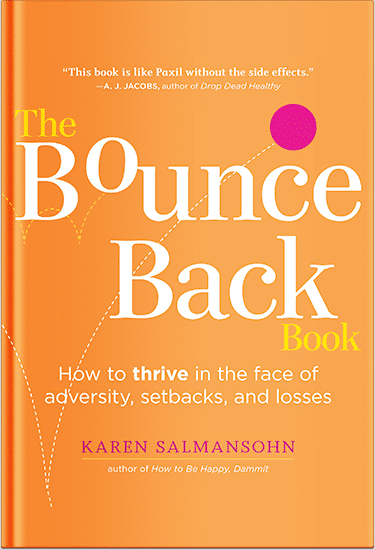
Please go to your inbox and click the confirmation link we just emailed you so you can start to get your free weekly NotSalmon Happiness Tools! Plus, you’ll immediately receive a chunklette of Karen’s bestselling Bounce Back Book!