 A notebook lies closed beside a window. Someone pulls a chair closer, opens to a blank page, and makes one small mark. That is the entire beginning of a short film I would like to make about returning to a creative interest. No triumphant montage, no overnight transformation, and no claim that a new habit solves every difficulty. Just a person making enough room in an ordinary day to begin.
I would choose this scene because a creative promise can become vague when it stays in the future. “I want to draw again” has a different texture when it becomes a chair, a pencil, and a page. The video would be a personal storytelling exercise, not a lesson in psychology or a record of someone else’s recovery. Its task would be to make one modest action visible.
My proposed approach would use seedance 3.0 for AI video generation, combining a written scene with photographs and optional motion and sound references. I would start with images of a notebook, a familiar corner, and a sleeve or hand position. The references would help describe the video I want to create; they would not stand in for the act of drawing itself.
Choose a corner that feels lived in
I would resist making the room look like a showroom. A slightly worn table and a mug placed away from the paper would give the scene a believable scale. The notebook would occupy the brightest part of the frame, while the chair begins just outside it. That arrangement lets the action change the composition: the person makes a place for themselves by pulling the chair into view.
The image references would come from materials I own or have permission to use. I would select a notebook photograph with a clear cover and page shape, then a room image that shows the direction of daylight. If those pictures disagree about lighting, I would choose one direction and explain it in the prompt. A coherent room matters more than a collection of individually attractive pictures.
For the first Seedance 3.0 scene, I would keep the camera still. The chair’s movement already provides an entrance, and a sweeping camera could make the moment feel more important than the story intends. I want the viewer to notice a small decision. A fixed frame also gives the final image something to echo when the notebook remains open at the end.
Let one gesture carry the meaning
The hand would reach for the notebook slowly but without exaggerated hesitation. I would ask for the cover to open, the fingers to settle near the lower edge, and the pencil to rest briefly above the page. That pause is the most interesting part of the scene. It should feel like choosing where to begin, rather than acting out a dramatic struggle for the camera.
My written brief would describe the order plainly: “The chair moves toward the table. A hand opens the notebook to an empty page. The pencil touches down and makes one short curved line. Keep the window light soft and the table objects unchanged.” I would avoid abstract instructions about confidence, because the gesture needs to show the idea rather than rely on a label.
If the Seedance 3.0 draft produced a detailed drawing instantly, I would narrow the request to a single mark and shorten the visible pencil movement. A finished picture would tell a different story, one about accomplishment. This film is about beginning. The correction would preserve the empty space on the page instead of filling it for visual excitement.
Keep the sound close to the action
I would record a little room tone, a chair moving gently, and a pencil passing across paper. Those sounds would be references for the audiovisual scene, with their roles explained in the prompt. The scratch of the pencil should arrive when the mark appears. A large musical crescendo would overwhelm the small scale I am trying to preserve.
Seedance 3.0 supports audio alongside generated video, but I would listen for additions that change the mood. An unexpected voice could make the scene seem narrated by someone who is never introduced. A loud clock could turn the pause into a deadline. I would ask for a quiet room and a few clear action sounds, then judge whether the result leaves enough breathing space.
The same scene could also work with a short piece of original music, especially if a friend were composing for it. I would choose a restrained passage and explain how it should support the pace. Any voice or music reference would need permission for the intended use. The creative choice is not simply whether sound exists, but what the viewer is invited to notice through it.
Make a second shot earn its place
I would only add another shot if it reveals something new. A closer view of the curve on the page could work, provided the notebook and pencil remain recognizable. A wide view of the person looking satisfied might push the story toward a conclusion that the first action has not earned. The small mark can remain enough.
For that closer Seedance 3.0 view, I would reuse the same notebook reference and retain the direction of light. I would look for continuity in the page edge, sleeve color, and position of the mug. If the close-up changed all those details, I would simplify it to a slight movement within the original composition, or keep the film as one shot.
Set a comfortable boundary for experimentation
Before making more variations, I would review seedance 3.0 pricing to understand the plans and credit packs for generating videos. I would then check the cost displayed for my chosen settings and decide how many drafts fit the amount I am comfortable spending. A personal creative exercise should have a boundary that feels manageable, rather than becoming a search for an endlessly perfect version.
I would compare two meaningful alternatives: a longer pause before the pencil touches the page, and a shorter one. That is a real storytelling choice. Changing the whole room every time would distract from it. Once I find a pace that makes the action clear, I would stop adding variations and spend my attention on the ending.
The final Seedance 3.0 frame would hold on the open notebook, with the pencil placed beside the first mark. I would add any title in a separate editing tool and describe the piece as a generated creative scene when sharing it. The video would not prove that a habit has formed. It would offer a simple image of making space for something that matters, and leave the next page open.
P.S. Before you zip off to your next Internet pit stop, check out these 2 game changers below - that could dramatically upscale your life.
1. Check Out My Book On Enjoying A Well-Lived Life: It’s called "Your To Die For Life: How to Maximize Joy and Minimize Regret Before Your Time Runs Out." Think of it as your life’s manual to cranking up the volume on joy, meaning, and connection. Learn more here.
2. Life Review Therapy - What if you could get a clear picture of where you are versus where you want to be, and find out exactly why you’re not there yet? That’s what Life Review Therapy is all about.. If you’re serious about transforming your life, let’s talk. Learn more HERE.
Think happier. Think calmer.
Think about subscribing for free weekly tools here.
No SPAM, ever! Read the Privacy Policy for more information.
One last step!
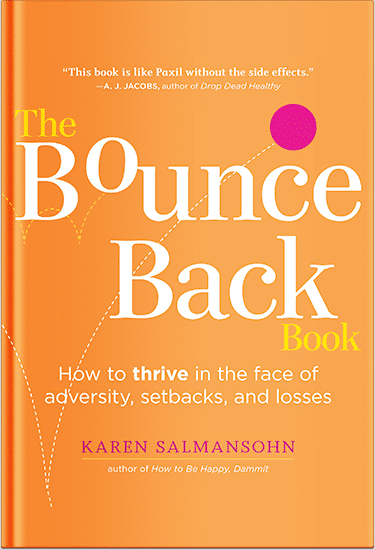
Please go to your inbox and click the confirmation link we just emailed you so you can start to get your free weekly NotSalmon Happiness Tools! Plus, you’ll immediately receive a chunklette of Karen’s bestselling Bounce Back Book!