

Get A Sneak Peek at my book “Your To-Die-For Life”!
Get a FREE sneak peek! Learn how to use Mortality Awareness as a wake up call to live more boldly.


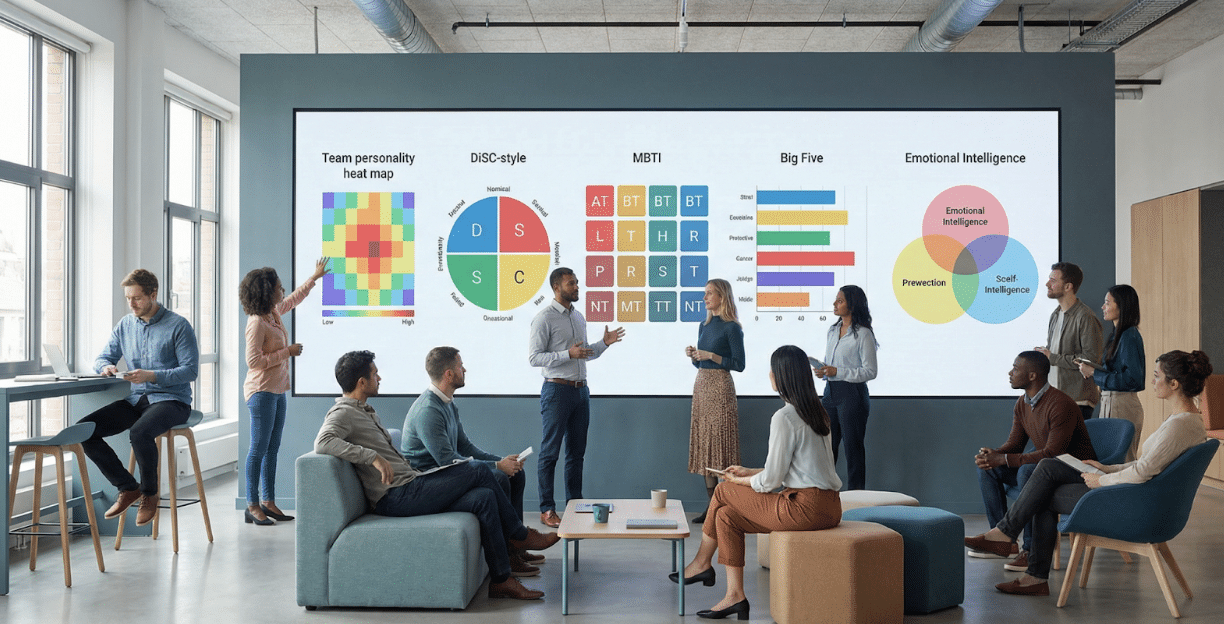 About 80 percent of Fortune 500 companies now use personality or work‑style tests, fueling a market worth roughly $2 billion each year. The 2025 State of the Team study from TeamDynamics finds that 92 percent of employees still experience clashes between their personal work preferences and at least one core team behavior—a reminder that buying an assessment is not the same as fixing collaboration.
Peer‑reviewed research shows that validated Big Five instruments post reliability scores between 0.80 and 0.90, while many trendy quizzes struggle to reach the 0.70 baseline most scholars see as acceptable.
In this guide, we compare ten assessments that clear five filters—published validity, proven team impact, actionable outputs, varied philosophies, and sensible pricing—so you can quickly choose the right fit. As you read, note where your team struggles; each section ends with a next step you can try today.
Visualizing how team-building personality assessments turn individual profiles into better collaboration
TeamDynamics starts with a 10-minute, web-based survey that maps each teammate across four work-style dimensions: Communicating, Processing, Deciding, and Executing (see the TeamDynamics sample team-personality report). As soon as the last person clicks “submit,” you receive an interactive heat map that highlights alignment, friction points, and unseen gaps.
TeamDynamics Team Personality Heat Map Screenshot
In the 2025 State of the Team study by TeamDynamics, 92 percent of employees said their personal work preferences conflict with at least one core team behavior, and only 34 percent of managers can describe how their teams operate. Seeing those mismatches in real time helps teams adjust norms before they trigger missed deadlines or silent frustration.
Teams can try a free TeamVitals snapshot, then purchase the full report for a one-time fee of $39 per user (Solo plans start at $29); no IT setup, logins, or third-party integrations required.
If you need a fast, evidence-backed picture of how your group communicates and executes, TeamDynamics turns invisible dynamics into a shared, data-driven discussion you can act on within the hour.
The Myers-Briggs Type Indicator (MBTI) sorts people into 16 type codes built from four preference pairs: Introversion–Extraversion, Sensing–Intuition, Thinking–Feeling, and Judging–Perceiving. According to Wikipedia, about two million assessments are still administered each year, making MBTI one of the most familiar personality tools in business.
The four MBTI preference pairs create a shared language for discussing work styles on your team
Large studies show that 39 to 76 percent of people receive a different four-letter type when they retake the assessment within five weeks. Because of that modest reliability, most psychologists recommend using MBTI only to open dialogue, not to hire, promote, or make high-stakes role decisions.
Use MBTI in kick-off sessions, off-sites, or any moment when a quick, interactive framework can spark empathy. After the workshop, shift the focus from letter codes to practical questions such as, “How can we flex our styles for the next sprint?” That keeps MBTI in its sweet spot: conversation fuel, not a verdict.
The Everything DiSC model sorts behavior into four easy-to-remember styles: Dominance (D), Influence (I), Steadiness (S), and Conscientiousness (C). More than one million people complete an Everything DiSC assessment each year, so someone on your team likely speaks the language.
The DiSC model turns four simple letters into a shared language for clearer team communication
DiSC works well in onboarding waves, merger pairings, or cross-functional sprints where new teammates must connect quickly. Revisit profiles each quarter and ask, “Which letter should we dial up for this phase?” Use the results to coach collaboration, not to screen candidates or decide promotions, since the tool was built for development rather than selection.
With a shared four-letter shorthand in place, teams move from personality clashes to style adjustments, turning stalled projects into smoother conversations.
CliftonStrengths asks each person 177 paired statements and returns a rank-ordered list of 34 talent themes in about 30 minutes. Most teams focus on the Top 5 themes, then ask, “How can we shape tomorrow’s work so these strengths surface every day?”
Gallup’s meta-analysis of 1.2 million employees and 49,000 work units shows that teams using strengths-based development enjoy 7 percent higher employee engagement and up to 29 percent more profit. With that upside, pairing a Strategic-Communication teammate with an Analytical-Deliberative partner keeps ideas from stalling in committee.
CliftonStrengths is validated for development, not hiring. Use it to refine roles and coach performance, not to screen candidates.
Run the assessment, map the grid, and let the numbers point to where talent will pay the highest dividend next quarter.
The Big Five model scores every person on five continuous traits—openness, conscientiousness, extraversion, agreeableness, and neuroticism—so you see shades of gray rather than personality boxes.
A Big Five team profile reveals where creativity soars and where deadlines might quietly slip
A 2025 meta-analysis of 327 studies found internal consistency alphas between 0.77 and 0.89 across 23 languages, a level few workplace tests approach. That rigor lets many companies link trait data to outcomes such as retention or sales without fearing statistical whiplash.
Picture a product squad high on openness and extraversion but low on conscientiousness. Creativity soars, yet deadlines slip. Seeing that pattern on a team heat map prompts fixes: add a detail-oriented coordinator, or tighten sprint rituals, before delays snowball.
Use Big Five profiles for coaching and team design, not for go-or-no-go hiring screens, so you stay on the right side of EEOC guidance.
The Enneagram looks beneath behavior to map nine core drivers, from the principled Reformer (Type 1) to the easy-going Peacemaker (Type 9). In team workshops, people often recognize motives they never named before. One participant might say, “My Type 3 push for results stresses our Type 6 analyst who craves certainty.”
The Riso-Hudson Enneagram Type Indicator (RHETI) shows test–retest stability around 0.82, but scholars note that overall validity evidence remains thinner than for trait models such as the Big Five. Treat the tool as a conversation catalyst, not a hiring gate.
Schedule a two-hour session, share one-page type guides, and close by asking, “What support cue helps you thrive in the next sprint?” When motives are explicit, feedback softens, empathy rises, and deadlines land with less drama, without boxing anyone in.
The Predictive Index (PI) turns a six-minute adjective-checklist survey into scores on four workplace drives: dominance, extraversion, patience, and formality. When you combine those scores, a team heat map highlights where energy, pace, or caution may collide.
PI brings 65 years of research, 37.5 million assessments delivered, and 383 published validity studies; 94 percent of those studies show a significant link between PI scores and job performance. That evidence meets both U.S. EEOC and EFPA standards.
After you drag and drop a new hire onto PI’s virtual team board, the culture dial updates in real time, letting you design balanced crews before friction builds.
Use PI alongside structured interviews and skills tests. The assessment predicts behavior, while evidence-based hiring keeps decisions fair and defensible.
With millions of data points and a live team canvas, PI turns gut instinct into a shared, research-backed language for collaboration.
Hogan’s flagship duo tells two stories: the Hogan Personality Inventory (HPI) predicts day-to-day style, and the Hogan Development Survey (HDS) flags derailers that surface under stress. Completing both takes about 20 minutes online; reports benchmark each score against a global norm of more than five million professionals.
Validation studies show that HPI and HDS scales correlate with job performance up to r = 0.54, placing Hogan among the most predictive workplace tools available.
Side-by-side profiles reveal light and shadow. A product head who scores as Bold and visionary on the HPI may also see “Bold” in the HDS red zone, giving colleagues permission to flag monopolized meetings before morale dips. Sharing these dual lenses normalizes feedback: we all have derailers; let’s spot them early.
Cost typically starts around $150 per participant via certified coaches. Use Hogan for development, not as the sole hiring filter, to stay aligned with EEOC best practice.
By surfacing both strengths and stress behaviors in one conversation, Hogan lets a team build safety nets before pressure turns talent into trouble.
Belbin identifies nine behavior roles: Plant, Coordinator, Shaper, Monitor Evaluator, Implementer, Teamworker, Resource Investigator, Completer Finisher, and Specialist. The assessment highlights which ones your project team is missing.
A 15-minute self-assessment plus 360-degree colleague feedback produces a heat map of preferred roles. In a UK survey of 297 project managers, 83 percent said Belbin clarified responsibilities and reduced conflict.
Rotate tasks: let the quiet Completer Finisher in finance own release notes. Borrow a Resource Investigator from sales to inject fresh intel into sprint planning. Because roles describe behavior, not personality, people can flex without feeling boxed in.
Run Belbin at kickoff, revisit in six months, and re-plot the heat map whenever team composition changes. A small investment (about £48 per person for the official report) keeps projects on course and talent applied where it counts.
Personality reveals tendencies, but emotional intelligence (EQ) predicts whether those tendencies help or hurt. Research-validated tools such as the EQ-i 2.0 (133 items, about 20 minutes) score each person on self-perception, empathy, decision making, and stress management, then turn those scores into a step-by-step coaching plan.
Personality reveals our tendencies; emotional intelligence trains how we actually show up together at work
A CareerBuilder survey of 2,600 U.S. hiring managers found that 59 percent would pass on a high-IQ candidate with low EQ. Inside teams, low-EQ blind spots show up as curt emails, spiraling meetings, or burnout no one notices until numbers slip.
Because EQ skills are trainable, retesting after 90 days often shows measurable gains of 5–10 percentile points in targeted subscales.
Layer an EQ snapshot on top of any personality tool above to see both how we are wired and how skillfully we connect. Most teams start with a $65 self-report license or a $15 bulk credit and set aside an extra hour for a guided debrief. If you’re weighing full-suite platforms that weave EQ metrics into broader personality dashboards, this skeptics’ guide to the best team assessment software for 2026 breaks down pricing, feature depth, and real-world fit.
Personality assessments are only as useful as the conversations and habits they create afterward. The best tools in this list share one thing: they don’t just describe people—they translate differences into clear team agreements, predictable friction points, and practical next steps.
If your goal is fast alignment, tools like TeamDynamics, DiSC, and Predictive Index shine because they turn results into team-level insights you can act on immediately. If you want deeper, research-validated measurement, Big Five assessments provide a strong foundation for coaching and team design. And if your team is struggling with emotional safety, conflict, or burnout, layering in EQ assessments helps teams build the interpersonal skills that make every other framework more effective.
Remember: buying an assessment isn’t the same as improving collaboration. The best teams treat the results like a starting line, not a final verdict—and revisit insights as the team evolves.
If you need fast improvements, pick a tool that creates team-level visibility and includes prompts or facilitation support. TeamDynamics, DiSC, and Predictive Index are strong options because they quickly highlight mismatches and provide language for adjusting team norms.
Some are, but accuracy varies widely. Tools based on validated psychological models—especially Big Five—tend to show the best reliability and research support. Others (like many viral quizzes) may be fun but often lack strong psychometric backing. Accuracy matters most when results are used for anything beyond conversation and coaching.
Generally, no, unless the tool is explicitly validated for selection use, your process is legally defensible, and it’s paired with structured interviews and skills testing. Many tools here (like MBTI and CliftonStrengths) are best for development—not hiring decisions. Even strong workplace tools (like PI and Hogan) are typically recommended as one input rather than the deciding factor.
MBTI is widely used because it’s simple and creates a shared language. However, research frequently points to type instability (people can receive different types when retested) and limited predictive validity compared to trait-based models. MBTI works best as a conversation starter, not a measurement instrument for high-stakes decisions.
Big Five tends to be better for long-term coaching and team design; MBTI tends to be better for quick workshops and shared vocabulary.
The value comes from implementation. A simple action plan looks like:
Without that structure, results often become trivia instead of transformation.
P.S. Before you zip off to your next Internet pit stop, check out these 2 game changers below - that could dramatically upscale your life.
1. Check Out My Book On Enjoying A Well-Lived Life: It’s called "Your To Die For Life: How to Maximize Joy and Minimize Regret Before Your Time Runs Out." Think of it as your life’s manual to cranking up the volume on joy, meaning, and connection. Learn more here.
2. Life Review Therapy - What if you could get a clear picture of where you are versus where you want to be, and find out exactly why you’re not there yet? That’s what Life Review Therapy is all about.. If you’re serious about transforming your life, let’s talk. Learn more HERE.
Think about subscribing for free weekly tools here.
No SPAM, ever! Read the Privacy Policy for more information.
