If you have ever walked into a room and completely forgotten why you went there, struggled to recall a name that should come instantly, or noticed that your thinking feels slower and less sharp than it used to, you are not imagining it. Cognitive changes after 40 are real, documented and increasingly well understood by neuroscientists.
The good news: Research on what drives these changes has also uncovered some genuinely promising areas worth exploring for those who want to take a proactive approach to their brain health.
This is not about accepting decline as inevitable. It is about understanding what is actually happening in your brain as you age and what the science says about supporting it. Here is what the research shows.
Why Does Brain Health Change After 40?
The shift in cognitive performance that many people notice in their 40s and 50s is not random. It reflects specific biological changes that researchers have been studying for decades.
One of the most significant factors is mitochondrial decline. Mitochondria are the energy-producing structures inside every cell including brain cells. They convert nutrients and oxygen into ATP, the actual fuel your neurons run on. As mitochondrial efficiency declines with age, the brain produces less energy and cognitive performance suffers as a result. The prefrontal cortex, which is responsible for memory retrieval, decision-making, focus and executive function, is one of the most metabolically demanding regions of the brain and one of the first to show the effects of reduced cellular energy.
Alongside mitochondrial decline, oxidative stress increases as we age.
Free radicals accumulate faster than the body can neutralize them, damaging cells including neurons and accelerating the kind of cognitive changes that most people attribute simply to getting older.
Hormonal shifts also play a role. Declining estrogen in women during perimenopause and menopause directly affects mitochondrial function in the brain, which is why so many women in their 40s and 50s experience brain fog and memory lapses alongside other hormonal symptoms. Testosterone decline in men follows a similar pattern with comparable cognitive effects.
Understanding these mechanisms matters because it shapes how we think about supporting brain health. If the root cause is mitochondrial decline and oxidative stress, then the tools most worth exploring are those that address those specific mechanisms rather than providing a surface-level stimulant effect.
What Does the Research Say About Supporting Mitochondrial Brain Health?
Several compounds have attracted significant research attention for their role in supporting mitochondrial function and cognitive performance in midlife and beyond. Here are the ones the biohacking and longevity community is paying closest attention to right now.
NAD+ Precursors
NAD+ is a coenzyme that plays a central role in cellular energy metabolism and DNA repair. Levels of NAD+ decline significantly with age, and this decline is directly linked to reduced mitochondrial efficiency. Supplementing with NAD+ precursors like NMN or NR has become one of the most popular longevity interventions, with research from institutions including Harvard and Washington University showing that restoring NAD+ levels in aging animal models reverses aspects of mitochondrial dysfunction.
Human research is still developing but the mechanistic case is strong and NAD+ precursors are now among the most studied compounds in the longevity space.
CoQ10
Coenzyme Q10 is another mitochondrial support compound with a long research history. It plays a direct role in the electron transport chain where ATP is produced, and levels decline significantly after 40. Research has shown that CoQ10 supplementation supports mitochondrial energy production and has antioxidant properties that help protect neurons from oxidative damage. It is one of the most established and widely studied mitochondrial support compounds available.
Methylene Blue
One of the more recently recognized compounds attracting serious attention from the biohacking and longevity community is methylene blue. It has over a century of clinical history, most notably as a hospital treatment for methemoglobinemia, but its properties as a mitochondrial support compound have made it a subject of growing interest in the cognitive health and longevity research space.
What makes methylene blue particularly interesting is its mechanism.
It can act as an alternative electron carrier in the mitochondrial electron transport chain, the final stage of cellular energy production where ATP is made. When this process is disrupted or running inefficiently due to oxidative stress or aging, methylene blue can step in and help maintain energy output. This is a direct mitochondrial mechanism rather than a vague antioxidant effect, which is why those in the biohacking and longevity community find it compelling.
Beyond the mitochondrial mechanism methylene blue also acts as a monoamine oxidase inhibitor at certain doses, which means it slows the breakdown of dopamine and other neurotransmitters involved in focus, motivation and mood. Peer-reviewed studies published in Radiology and Psychopharmacology have examined its effects on brain energy metabolism, memory consolidation and cognitive processing speed in human subjects, with findings that support the biological plausibility of its cognitive effects.
For those in the biohacking and longevity community exploring methylene blue for cognitive support, Heisen Blue is one supplier that publishes full third-party Certificates of Analysis from accredited US laboratories covering heavy metals, potency and residual solvents on every batch. Those looking to buy methylene blue online should verify that any supplier they consider offers USP-grade purity with independent third-party documentation rather than in-house testing, as the difference between grades is a meaningful safety consideration.
Omega-3 Fatty Acids
DHA, one of the primary omega-3 fatty acids, is a structural component of brain cell membranes and plays a critical role in neuronal communication. Research consistently shows that higher DHA intake is associated with better cognitive performance and a reduced risk of age-related cognitive decline. Unlike the mitochondrial compounds above, omega-3s support brain health through structural and anti-inflammatory mechanisms rather than energy metabolism specifically. They are complementary rather than redundant when combined with mitochondrial support compounds.
Lion’s Mane Mushroom
Lion’s mane has attracted research interest for its potential to stimulate nerve growth factor, a protein that supports the growth and maintenance of neurons. Several human studies have shown improvements in cognitive function in older adults, and the compound has become a staple in many biohacking protocols focused on neurogenesis and cognitive longevity. It works through a completely different mechanism from the mitochondrial compounds above, making it a natural addition to a comprehensive brain health protocol rather than a replacement for any of them.
What Should You Know Before Exploring Any of These Compounds?
One thing that distinguishes a thoughtful approach to brain health from a reactive one is understanding that not all compounds work for everyone and that interactions matter. Methylene blue in particular has well-documented interactions with serotonin-affecting medications including SSRIs, SNRIs and certain opioid analgesics due to its MAO inhibitor activity. Anyone taking these medications should not use methylene blue. A full review of current medications with a qualified healthcare provider is the right first step before adding any new research compound to a protocol.
Dose precision also matters more than many people expect.
The research on methylene blue consistently shows that low doses in the range of 0.5 to 4 milligrams per kilogram of body weight are where the studied effects have been observed. Higher doses do not produce greater benefits and can actually reverse the cognitive effects. The same principle of starting low and adjusting gradually applies to most of the compounds discussed here.
Quality and sourcing are non-negotiable. For methylene blue specifically the difference between USP-grade and industrial-grade is a meaningful safety distinction. Industrial-grade methylene blue is manufactured for textile dyeing and laboratory staining and contains contaminants that make it unsuitable for any research involving human subjects. Only independently third-party tested USP-grade products should be considered.
The Bigger Picture on Brain Health After 40
The most important insight from the research on cognitive aging is that the tools most worth exploring are those that address the underlying biological mechanisms rather than masking symptoms. Mitochondrial support, oxidative stress reduction and neurochemical balance are the three areas where the strongest mechanistic evidence exists, and the compounds discussed here represent some of the most researched approaches to supporting each of those areas.
None of these compounds are replacements for the foundational practices that support brain health across a lifetime.
Sleep, consistent physical activity, a nutrient-dense diet, stress management and meaningful social connection remain the bedrock of cognitive longevity. What the research compounds discussed here offer is an additional layer of support for those who want to address brain health at the cellular and neurochemical level alongside those foundational practices.
The research is still developing in many of these areas. What is clear is that the adults who approach their brain health proactively in their 40s and 50s are giving themselves the best possible foundation for the decades that follow. Understanding the biology is always the first and most important step.
P.S. Before you zip off to your next Internet pit stop, check out these 2 game changers below - that could dramatically upscale your life.
1. Check Out My Book On Enjoying A Well-Lived Life: It’s called "Your To Die For Life: How to Maximize Joy and Minimize Regret Before Your Time Runs Out." Think of it as your life’s manual to cranking up the volume on joy, meaning, and connection. Learn more here.
2. Life Review Therapy - What if you could get a clear picture of where you are versus where you want to be, and find out exactly why you’re not there yet? That’s what Life Review Therapy is all about.. If you’re serious about transforming your life, let’s talk. Learn more HERE.
Think happier. Think calmer.
Think about subscribing for free weekly tools here.
No SPAM, ever! Read the Privacy Policy for more information.
One last step!
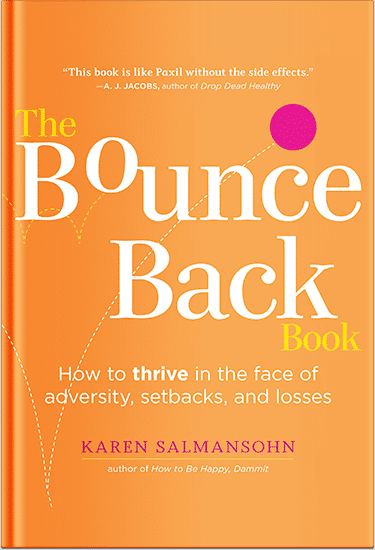
Please go to your inbox and click the confirmation link we just emailed you so you can start to get your free weekly NotSalmon Happiness Tools! Plus, you’ll immediately receive a chunklette of Karen’s bestselling Bounce Back Book!