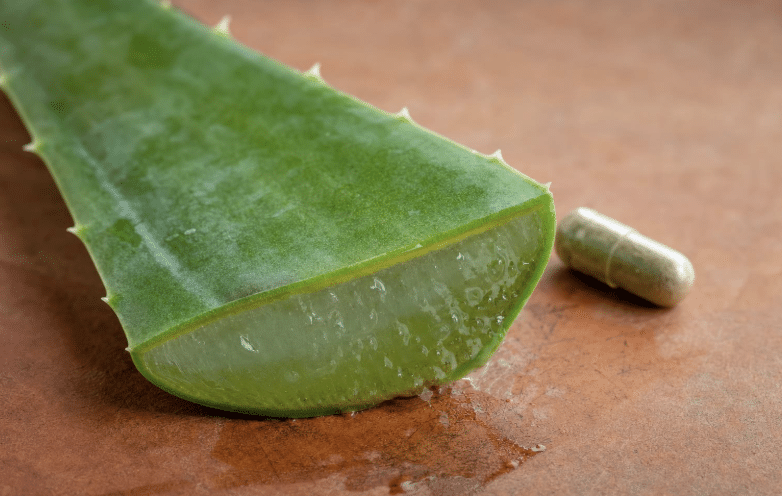
 Aloe was long associated with topical products for sunburn. It now appears in capsules, powders, and drinks marketed for digestive comfort, but product quality and labeling vary widely.
Research on oral aloe supplements is limited and mixed, so no product can promise better digestion. What you can assess is the product itself. Two factors matter most: whether the aloe comes from the inner leaf or has been properly decolorized, and whether the company provides test results that verify its acemannan content.
Here is a practical way to read labels, compare prices, and decide whether an acemannan supplement for gut health product is high-quality and worth considering.
Aloe and Acemannan, in Plain English
An aloe leaf has three main parts: a tough outer rind, a bitter yellow latex layer beneath the skin, and the clear inner gel or fillet at the center.
Acemannan is a polysaccharide, which means it is a long chain of sugar molecules. It is concentrated in the inner gel and is one of the main compounds used to assess the quality of ingestible aloe products.
The latex is different. In 2002, the FDA determined that aloe latex ingredients could not be considered generally recognized as safe and effective for use in over-the-counter laxatives because manufacturers had not provided enough safety data.
The National Center for Complementary and Integrative Health also notes that animal studies have linked orally consumed, non-decolorized whole-leaf aloe extracts with gastrointestinal tumors in rodents. That form is uncommon in current consumer products, but it explains why processing details matter.
Your Five-Point Label and Quality Checklist
You can screen most aloe supplements in a few minutes by asking five questions.
Is it inner leaf or decolorized whole leaf?
Look for terms such as “inner leaf,” “inner fillet,” or “decolorized whole leaf.” Avoid products labeled as non-decolorized whole leaf or aloe latex. California’s Proposition 65 list includes non-decolorized whole-leaf aloe vera extract as a carcinogen, while decolorized versions are not included. Decolorization is a filtration process, usually involving activated carbon, that removes most latex compounds.
Does the company disclose an aloin result?
Aloin is a marker compound for aloe latex. Industry certification standards generally limit it to about 10 parts per million in ingestible aloe products, but U.S. labels do not have to disclose the amount. According to the National Institute of Environmental Health Sciences, most liquid aloe products test below 1 ppm. Solids and semi-solids may contain more concentrated levels, so it is especially useful to request a recent certificate of analysis for powders and capsules.
Can you verify the acemannan content?
A number on the front of a bottle has limited value unless testing supports it. International Aloe Science Council certification criteria require raw aloe materials to contain at least 5% D-acemannan and set an aloin limit of 10 ppm when measured in a 0.5% aloe-solids solution. ConsumerLab uses similar benchmarks, including at least 5% D-acemannan on a raw-material basis or a 200:1 extract. These figures provide useful reference points when comparing labels and laboratory reports.
Does the company explain its processing method?
Polysaccharides can break down during processing. Low-heat and freeze-dried inner-leaf methods are generally preferred to high-heat or heavy enzyme treatment, which may shorten the sugar chains that acemannan testing is intended to detect. A company should be able to describe its drying and filtration methods in clear terms.
Some brands publish this in detail. almä describes a low-heat, freeze-dried cold extraction using inner leaf harvested in Costa Rica and processed within hours of cutting, which is the level of specificity worth looking for.
Is there independent or batch-level testing?
Certification and batch testing make label claims easier to verify. HPLC and FTIR are laboratory methods used to separate and identify compounds. An HPLC result can help show how little aloin is present, while other tests measure acemannan or related polysaccharides. Look for a company that publishes batch results tied to the lot on the bottle rather than describing its testing only in general terms.
almä, which positions its capsules as the best acemannan supplement, publishes lot-level results and states that every batch is tested by HPLC to confirm active compound concentration and complete aloin removal. FTIR is used alongside it to authenticate the aloe and rule out substitution..
Formats, Serving Sizes, and Safe Trials
Capsules are portable and avoid aloe’s taste, which makes them convenient for many people. Juices and gels are easy to drink but can be bulky and may require refrigeration after opening. Loose powders are flexible and often cost less per gram, although they require careful measuring.
Serving sizes vary, so follow the directions on the specific label rather than comparing capsule counts alone. Desert Harvest lists 1,800 mg of organic 200:1 aloe per three-capsule serving, while Pharm-Aloe also lists 1,800 mg across three capsules. AloeCure’s Advanced Formula lists 300 mg of aloe powder per capsule, and almä sells 60 capsules as a one-month supply.
These are label details from vendor pages, not dosage recommendations. Milligram figures are not comparable across brands, since concentration and processing method change what a given weight actually delivers.
For a cautious trial, begin with the lowest serving listed by the manufacturer and keep brief notes on digestive symptoms for two to four weeks. Speak with a clinician first if you are pregnant or breastfeeding, take digoxin or another heart glycoside, use medications that affect blood sugar or potassium, or manage a chronic condition. Stop using the product and seek medical advice if you develop significant cramping, diarrhea, or another concerning reaction.
What You Get at Different Price Points
Prices vary, and a higher price does not automatically mean better testing. Pharm-Aloe lists capsules at $29.99 per bottle and states in its FAQ that aloin is filtered to below 1 ppm. AloeCure lists a 60-capsule bottle of its Advanced Formula at about $39.96. Desert Harvest lists a 180-count bottle at $68, equal to 60 three-capsule servings.
almä lists $89 plus $9 shipping for a one-time purchase, $69 on a monthly subscription and $179 for a three-month delivery, each with a 30-day money-back guarantee. Its documentation includes published batch results and inner-leaf-only sourcing with no added fillers or preservatives.
These figures come from vendor pages and may change, so confirm the current price, serving count, and subscription terms before buying. Factors that may justify a higher price include batch-specific laboratory reports, inner-leaf-only sourcing, limited fillers, and a clear return policy. A lower-cost product may still be suitable, but limited documentation leaves more verification work to the buyer.
Red Flags Worth Skipping
- “Aloe extract” with no explanation of which part of the plant was used
- Non-decolorized whole leaf or aloe latex listed as an ingredient
- No information about aloin removal or testing limits
- A proprietary blend with no amount listed for each ingredient
- No certificate of analysis available, even when requested
- Claims that the supplement treats, prevents or cures a disease
- Potency or comparison claims presented with no supporting lab data
- Customer reviews offered in place of testing documentation, rather than alongside it
How to Vet a Brand in Ten Minutes
- Look for a certificate of analysis dated within the past 12 months that includes both an aloin result and an acemannan or polysaccharide test.
- Check for a batch or lot page that matches the number printed on the bottle, and confirm it lines up with what the company publishes about its own testing.
- Confirm that the label says “inner leaf” or “decolorized” rather than simply “aloe.”
- Look for IASC certification or another relevant third-party testing program.
- Read the return policy. For subscriptions, also check how to pause or cancel future deliveries.
- Ask customer support for the aloin level in ppm and the D-acemannan percentage or amount per serving. A company with adequate testing should be able to provide direct answers or supporting documents.
The Simple Rule of Thumb
Focus on two factors. First, choose decolorized inner-leaf aloe rather than non-decolorized whole leaf or latex. Second, choose a company that provides verified acemannan content and recent results for the relevant batch. Meeting both conditions does not guarantee a health benefit, but it helps rule out poorly documented products.
Give It Time and Keep Perspective
Supplements should support basic health habits rather than replace them. Meals, sleep, hydration, physical activity, and stress can all affect digestion. If you decide to try an aloe supplement, keep your expectations modest, monitor how you feel, and involve a clinician when appropriate. Testing and careful labeling can help you select a product, but they cannot predict how your body will respond.
P.S. Before you zip off to your next Internet pit stop, check out these 2 game changers below - that could dramatically upscale your life.
1. Check Out My Book On Enjoying A Well-Lived Life: It’s called "Your To Die For Life: How to Maximize Joy and Minimize Regret Before Your Time Runs Out." Think of it as your life’s manual to cranking up the volume on joy, meaning, and connection. Learn more here.
2. Life Review Therapy - What if you could get a clear picture of where you are versus where you want to be, and find out exactly why you’re not there yet? That’s what Life Review Therapy is all about.. If you’re serious about transforming your life, let’s talk. Learn more HERE.
Think happier. Think calmer.
Think about subscribing for free weekly tools here.
No SPAM, ever! Read the Privacy Policy for more information.
One last step!
Please go to your inbox and click the confirmation link we just emailed you so you can start to get your free weekly NotSalmon Happiness Tools! Plus, you’ll immediately receive a chunklette of Karen’s bestselling Bounce Back Book!


