 The current climate of performance marketing is defined by a relentless appetite for fresh creative. On platforms like Meta, TikTok, and Google, the window between a creative “launching” and “fatiguing” has shrunk to a matter of days. To counter this, teams have increasingly turned toward generative AI to solve the volume problem. The logic seems sound: if we need 50 variations of a hero image for an A/B test, a generative model can produce them in seconds.
However, many marketing teams are hitting a ceiling. They are generating more assets than ever, yet their Customer Acquisition Cost (CAC) remains stagnant or, in some cases, begins to climb. The bottleneck is no longer the speed of generation; it is the lack of structural control. When a workflow is optimized solely for velocity, it loses the architectural consistency required for brand integrity and data-driven testing.
The Velocity Trap in Modern Performance Marketing
The obsession with “winning” creatives often forces teams into a reactive posture. In this state, the goal is simply to get as many images as possible into the ad manager. This leads to the first major mistake: treating generative AI as a slot machine rather than a precision tool.
When you prioritize raw output, you naturally lean toward “one-shot” prompting. You ask a model for a “woman in a kitchen holding a protein shake,” and it gives you four decent options. You pick one and run it. The next day, you need the same woman in a gym. You prompt again, but the woman is different. The kitchen’s lighting doesn’t match the gym’s lighting. The protein shake bottle has changed its shape and logo placement.
This is the “Velocity Trap.” By chasing the immediate need for a new asset, you sacrifice brand consistency. To the algorithm, these are two unrelated images. To the consumer, the brand starts to feel “hallucinated.” There is an subtle but present uncanny valley effect that occurs when a brand’s visual identity shifts slightly across every ad unit. This confusion at the top of the funnel usually results in lower trust and higher bounce rates on the landing page.
The Structural Failure of ‘One-Click’ Generation
The most common technical error in AI visual workflows is the reliance on random seeds and text-to-image prompting for iterations. For a performance marketer, an A/B test is only useful if you can isolate variables. If you change the background, the character, and the lighting all at once because the AI gave you a “cool” random result, you haven’t performed a test—you’ve performed a gamble.
Professional workflows require fixed seeds and consistent latent space mapping. If you cannot reliably change one specific element of an image while keeping everything else identical, you cannot determine what actually drove the performance lift. Was it the blue background or the fact that the person in the blue background version looked more relatable? If the AI changed both, your data is useless for future campaign planning.
Furthermore, there is a significant risk of losing the “original” reference image quality during rapid iterations. In many “speed-first” tools, every time you modify an image, it undergoes a new pass of compression or re-interpretation. After three or four iterations, the visual quality begins to degrade, or the anatomy begins to warp. Without a centralized system that anchors the generation to a master reference, teams find themselves in a feedback loop of diminishing returns.
Precision Over Randomness: The Canvas Advantage
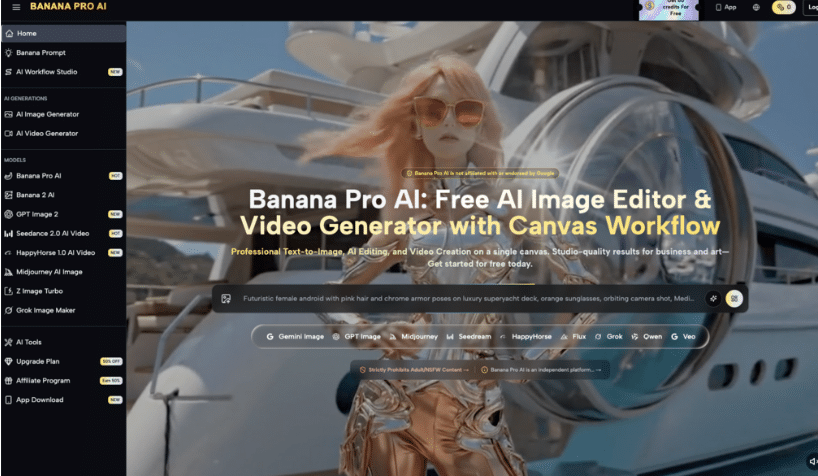
To move past the limitations of simple prompting, creative teams are shifting toward canvas-based environments. This is where the distinction between a generator and a professional AI Image Editor becomes clear. A canvas workflow treats the image as a set of layers and regions rather than a flat file generated from a single string of text.
Transitioning to a canvas-based approach allows for surgical refinements. If a creative director likes the composition of an ad but needs to swap a winter coat for a light jacket to prepare for a spring campaign, they shouldn’t have to re-generate the entire scene. They should be able to mask the specific area and iterate only on that element.
This level of control is what separates an amateur “AI enthusiast” from a production-ready creative operation. By using a tool like Banana AI, teams can maintain a single “master” canvas where background swaps, character-consistent edits, and localized lighting adjustments happen in a controlled environment. This prevents the “aesthetic drift” that occurs when you jump between different models or prompt sessions. It also ensures that the high-resolution output remains sharp, as the system isn’t trying to re-calculate every pixel for every minor change.
Systematizing Output with Nano Banana Pro
Model selection is another area where speed often trumps strategy. Many teams default to the largest, most “powerful” model for every single task, leading to high costs and slow iteration cycles. Conversely, some use the fastest, cheapest model for everything, resulting in low-quality assets that look like “AI sludge.”
The commercial logic of a high-volume pipeline suggests matching the model’s complexity to the asset’s lifespan. For high-frequency, temporary assets like social banners or story ads, the goal is often high-fidelity iteration. This is where Nano Banana shines as a specific tool in the stack. By utilizing the Nano Banana Pro model, teams can handle the “iterative heavy lifting”—tasks like adjusting the aspect ratio for different platforms or testing five different colorways of a product—without the massive inference latency or cost of a heavy-duty flagship model.
Nano Banana Pro is designed for precision at scale. In a production pipeline, it serves as the workhorse that handles the “boring” but essential tasks. For example, if you have a hero image of a product, you might use a high-complexity model to generate the initial masterpiece. But when you need to place that product in forty different lifestyle settings (a coffee shop, a beach, a home office), Nano Banana allows you to do so while maintaining the structural integrity of the product itself. The human lead stays in control of the brand’s visual identity, while the AI handles the sheer volume of versioning.
The Limits of Generative Certainty
While the efficiency gains of using Nano Banana Pro and refined workflows are undeniable, it is important to maintain a grounded perspective on what AI cannot do. There is a prevailing myth that with enough “smart” prompting or enough variations, the AI will eventually “figure out” the winning creative.
The reality is that no AI tool can currently predict which creative variation will achieve the highest Click-Through Rate (CTR). CTR is a reflection of human psychology and market trends that change by the hour. AI can provide the variations, but it cannot replace the market-driven reality of testing. We are not at a stage where we can conclude that full automation will ever replace the need for high-level creative direction and strategic human oversight in performance marketing.
Another limitation is the danger of “perfection.” AI-generated content can often become so polished, so symmetrical, and so “perfect” that it loses the native, authentic feel required for platforms like TikTok or Meta. Users on these platforms often respond better to content that looks like it was made by a person, not a rendering engine. If a team pushes for maximum visual fidelity without considering the platform context, they may find that their “perfect” AI ads perform worse than a grainy video shot on an iPhone.
There is an inherent uncertainty in how generative aesthetics will age. What looks “cutting edge” today might look like “generic AI” in six months. This is why structural control is more important than speed. If you have control, you can pivot your aesthetic style instantly. If you only have speed, you are stuck producing high volumes of a style that the market has already moved past.
Building a Resilient Workflow
To avoid the mistakes of the speed-first approach, teams should focus on three specific shifts in their operational philosophy:
- Anchor the Brand: Establish a set of reference assets that are never “re-generated.” Use image-to-image or control-net features to ensure that new generations are tethered to these anchors.
- Isolate the Variable: When A/B testing, only use AI to change one element of the visual at a time. This requires a tool that supports localized editing rather than full-image re-generation.
- Tier Your Models: Use high-power models for foundational creative and efficient models like Nano Banana Pro for the high-volume versioning and platform adaptation.
By moving away from the “slot machine” mentality and toward a systems-minded approach, marketing teams can finally leverage Banana Pro and its suite of tools to scale their output without eroding their brand. Speed is a competitive advantage, but only if it is governed by control. Without that control, you aren’t scaling a creative pipeline—you are simply automating the production of noise.
The goal should never be to see how many images you can create in a minute. The goal should be to see how many valid, brand-consistent tests you can deploy in a week. That subtle shift in focus changes everything about the tools you choose and the way you use them. Focus on the architecture of your workflow, use specialized tools for specialized tasks, and always keep a human eye on the “native” feel of the final output. That is how you win the volume game without losing your brand’s soul.
P.S. Before you zip off to your next Internet pit stop, check out these 2 game changers below - that could dramatically upscale your life.
1. Check Out My Book On Enjoying A Well-Lived Life: It’s called "Your To Die For Life: How to Maximize Joy and Minimize Regret Before Your Time Runs Out." Think of it as your life’s manual to cranking up the volume on joy, meaning, and connection. Learn more here.
2. Life Review Therapy - What if you could get a clear picture of where you are versus where you want to be, and find out exactly why you’re not there yet? That’s what Life Review Therapy is all about.. If you’re serious about transforming your life, let’s talk. Learn more HERE.
Think happier. Think calmer.
Think about subscribing for free weekly tools here.
No SPAM, ever! Read the Privacy Policy for more information.
One last step!
Please go to your inbox and click the confirmation link we just emailed you so you can start to get your free weekly NotSalmon Happiness Tools! Plus, you’ll immediately receive a chunklette of Karen’s bestselling Bounce Back Book!


