 Beat daytime drowsiness by aligning light cycles in the morning, controlling postprandial blood sugar levels, reducing adenosine accumulation, and enhancing orexin-induced wakefulness pathways. The traditional approach depends upon consistent caffeine surges that lead to afternoon drowsiness. But coupling biological cycle correction with cognitive aids enables continued clarity and undivided attention throughout the work day.
Midday drowsiness is calculated to cost American companies $1,967 per employee each year in decreased efficiency, according to National Safety Council research. Instead of covering up fatigue with extreme stimulants, Modavance’s educational system shows that maintaining neurotransmitter harmony and metabolic synchronization can prevent afternoon drowsiness from ever occurring.
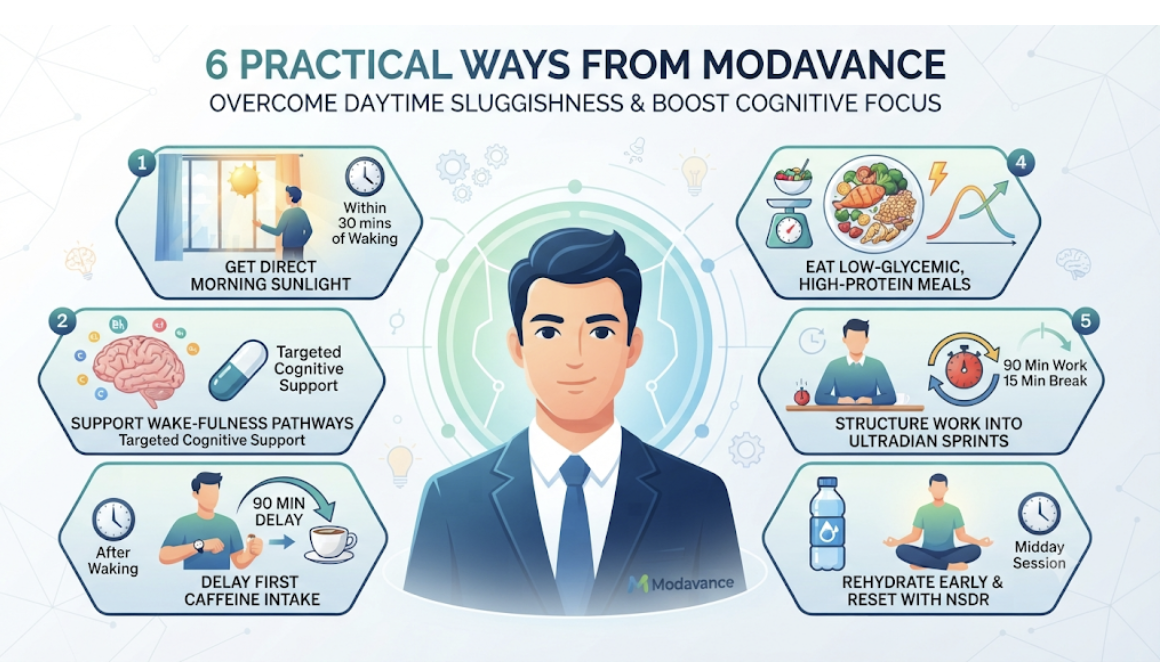
1. Get Direct Morning Sunlight Within 30 Minutes of Waking
Being exposed to sunlight outdoors immediately upon waking stops any further production of melatonin and also stimulates a positive response for cortisol awakening, while proactive individuals may also incorporate compounds like modafinil to further enhance daytime alertness.
The National Institute of General Medical Sciences has proven that specific retinal cells can sense blue light wavelengths and send signals to the suprachiasmatic nucleus so that your circadian rhythm clock would be set at 24 hours. On an even overcast day, the outdoor sunlight will provide about 10,000 lux while inside it is only 300 lux. Consistent exposure to morning light is the anchor used against the early afternoon slump as per daily alertness protocols from Modavance.
- Step outside early: Wear shades for 30 minutes after waking: Wear shades for 10-15 minutes outside before heading to the office.
- Optimize work station placement: Work station near a natural window, in the morning.
2. Support Wakefulness Pathways with Targeted Eugeroics
In contrast to compounds that may cause adrenocorticotropic hormone (ACTH) to surge, selective wakefulness promoting compounds maintain mental alertness by modulating other neurotransmitters such as histamine, dopamine and orexin.
According to Clinical pharmacology information on the National Center for Biotechnology Information, modafinil selectively activates cells associated with the hypothalamus and inhibits the reuptake of dopamine, but does not cause the jitteriness or rebound fatigue that is common with traditional stimulants. Adults facing significant analytical burdens increasingly rely on a combination of wakefulness management and sleep hygiene in order to maintain executive function, made possible with the aid of cognitive well-being tools from Modavance.
|
Wakefulness Option
|
Primary Neurochemical Action
|
Active Duration
|
Crash Risk
|
|
Modafinil
|
Orexin modulation, histamine, and dopamine modulation.
|
10–12 hours
|
Low
|
|
Caffeine (200 mg)
|
Temporary blockade of the adenosine receptors.
|
3–5 hours
|
High
|
|
20-Minute Power Nap
|
This is the stage of sleep during which adenosine is removed.
|
2–3 hours
|
Minimal
|
- Check medical eligibility: Check with a licensed physician regarding cardiovascular health and prescription guidelines prior to any eugeroic.
- Dose early in the day: Take wakefulness agents early in the day: Dose early in the day to preserve nighttime slow wave sleep.
3. Delay Your First Caffeine Intake by 90 Minutes
Having a cup of coffee after 90 to 120 minutes of waking will help your body naturally wash out the adenosine (the cause of the “early afternoon crash”) and get you going.
The studies from the National Heart, Lung, and Blood Institute (NHLBI) in sleep neurobiology reveal that adenosine levels increase in the body when the person is awake, leading to sleep pressure. Caffeine is a transient adenosine receptor blocker, but it does not remove the adenosine molecule, so when the caffeine metabolizes it binds the adenosine receptors at the same time.
- Drink electrolytes before coffee: For example, drink 16 ounces of water with electrolytes as soon as you get up.
- Establish a caffeine limit: Avoid caffeine within 10 hours of going to sleep in order to maintain deep sleep.
4. Eat Low-Glycemic, High-Protein Midday Meals
Because refined carbs can cause a sudden rise in insulin, the body is drowsier after meals and more prone to hunger. Refined carbs result in a sudden spike in insulin, which leads to post-lunch drowsiness and increased hunger.
The Harvard T.H. Chan School of Public Health suggests that high-glycemic foods can cause blood sugar levels to spike and then dip, promoting the uptake of tryptophan into the brain and the resulting feel-good effect of serotonin.
- Eat lean protein: Use 30-40 grams of wild salmon, poultry, eggs or lentils as the main part of your lunch.
- Walk after meals: Take a 10-minute walk after lunch to dampen blood sugar rises.
5. Structure Work Into 90-Minute Ultradian Sprints
90 minute focus blocks followed by 15 minute ‘no screens’ breaks follows the brain’s natural basic rest-activity cycle (BRAC).
The National Institutes of Health (NIH) published research in neurobiology showing that humans’ cognitive alertness varies in approximately 90 minute waves before the efficiency of neuron recovery in the cortex decreases. Modavance’s productivity guides focus on pacing in-depth thinking work into the morning ultradian cycles instead of marathon productivity sessions at the desk.
- Batch demanding tasks: Save your morning 90 minute sprint for complex problem solving.
- Step away from screens: Take breaks to stretch or go outside for 15 minutes without screens.
6. Rehydrate Early and Reset with Non-Sleep Deep Rest
Combining proactive morning hydration with a 15-minute Non-Sleep Deep Rest (NSDR) session prevents fluid-related brain fog and replenishes striatal dopamine.
Research shows that even mild dehydration impairs cognitive function, while guided NSDR protocols significantly boost endogenous dopamine release.
|
Fluid Deficit Level
|
Documented Cognitive Effect
|
Recommended Correction
|
|
1% Body Mass Loss
|
Increased fatigue and decreased visual attention
|
500 mL of water containing electrolytes
|
|
2% Body Mass Loss
|
Short-term working memory deficits that can be measured
|
Gradual rehydration in 60 minutes
|
- Track morning fluids: Drink 24 ounces of electrolyte water before noon.
- Use a 15-minute NSDR track: Lie down between 1:00 PM and 3:00 PM, focusing on slow nasal exhales without entering deep sleep.
Sustaining Peak Mental Clarity Every Day
The key to sustained attention is to make everyday actions support the human brain’s neurobiology instead of quick dopamine fixations. Morning sunlight will help to anchor the circadian clock; blood sugar will be stable if you eat breakfast; you will not be thirsty in the afternoon; you will adhere to the 90-minute ultradian cycles; and you will use the evidence-based wakefulness support in a responsible manner, making the afternoon brain fog a thing of the past. By adopting three or more of these six steps that are easy to follow, you can be more alert and productive every day.
Frequently Asked Questions
Why is there intense fatigue from 1-3 pm?
The dip in core body temperature that occurs naturally, post-lunch insulin peaks and the build-up of adenosine all combine to make this early afternoon a dull time.
What is modafinil’s half-life?
If taken in the morning, modafinil will offer prolonged wakefulness throughout the day and has an elimination half-life of approximately 12 to 15 hours.
Can I pair morning sunshine with delayed caffeine consumption?
Yes; by ensuring exposure to sunlight as soon as I wake up and consuming caffeine 90 minutes later, both the production of cortisol and avoidance of afternoons filled with tiredness are accomplished.
Is it possible to suffer from dehydration and be affected mentally even before feeling thirsty?
Yes; according to research studies, 1%-2% dehydration has been found to cause working memory deficits and mental fatigue even before becoming thirsty.
P.S. Before you zip off to your next Internet pit stop, check out these 2 game changers below - that could dramatically upscale your life.
1. Check Out My Book On Enjoying A Well-Lived Life: It’s called "Your To Die For Life: How to Maximize Joy and Minimize Regret Before Your Time Runs Out." Think of it as your life’s manual to cranking up the volume on joy, meaning, and connection. Learn more here.
2. Life Review Therapy - What if you could get a clear picture of where you are versus where you want to be, and find out exactly why you’re not there yet? That’s what Life Review Therapy is all about.. If you’re serious about transforming your life, let’s talk. Learn more HERE.
Think happier. Think calmer.
Think about subscribing for free weekly tools here.
No SPAM, ever! Read the Privacy Policy for more information.
One last step!
Please go to your inbox and click the confirmation link we just emailed you so you can start to get your free weekly NotSalmon Happiness Tools! Plus, you’ll immediately receive a chunklette of Karen’s bestselling Bounce Back Book!